Blocked-Ear Researcher Reveals: The Secret to Finally Opening a Clogged, Muffled Ear
The sentence that triggered the investigation: “I couldn’t hear my students asking questions or my colleagues speaking to me.”

I’m about to piss off every company still selling another wax kit or nasal spray as the answer to an ear that already looks completely clean.
Because after going through 180 real accounts of the same stubborn, clogged ear, I found something almost nobody checks—and once you see it, the entire clogged-ear routine looks completely backwards.
The instant one ear feels stuffed with wet cotton, every instinct tells you to attack the ear you can touch.
Clean it. Flush it. Check it for wax. Put drops in it.
Then, when the canal looks clean but the ear still feels blocked, spray the nose and hope the ear follows.
People do this for weeks. Sometimes years. They yawn until their jaw hurts. Chew gum. Pull the earlobe. Swallow over and over. Pinch the nose and blow until the ear crackles like it is finally about to open.
Maybe it clears for five seconds.
Then the next swallow muffles it again.
That is the ear I spent this investigation trying to understand.
And what I found is almost insultingly simple: the reason that ear won’t open has nothing to do with the part you keep cleaning.
It is not wax. It is not the canal you can reach with a cotton swab. It is not anything a drop or a spray was built to touch.
It is one small, overlooked thing—hiding somewhere you would never think to look, and almost no one bothers to check.
I’ll show you exactly where it is in a moment.
But first, I need to tell you about the one review that changed this entire investigation.
THE REVIEW I COULDN’T GET OUT OF MY HEAD
I was working through 180 experiences with the same simple powered device model.
Most described a familiar problem: one ear full, clogged, underwater, or stuck somewhere between popping and clearing.
Then I reached one written by a teacher.
“I couldn’t hear my students asking questions or my colleagues speaking to me.” Verbatim exact-product review • Review 37
That sentence stopped me.
She was not describing a little pressure after a flight. The clogged ear had followed her into the classroom and started deciding which voices reached her.
She had reached the point where one more medical visit had become a cost calculation:
“The ENT copay will be the same or more.” The same reviewer • Review 37
She did not need another person to look inside her ear and confirm what was visible. She needed a direct way to actually make it open.
Her words did not leave me alone.
I kept reading because I needed to know whether her experience was a fluke—and exactly what had changed.
THE MIND-BLOWING PATTERN HIDING IN 180 REVIEWS
That was the point where curiosity turned into obsession.
My job was not to collect another miracle quote. It was to understand why this almost stupidly simple device worked for her, why it failed for others, and what the normal clogged-ear routine kept missing.
So I stopped looking at star ratings and started looking at behavior.
So I pulled the reviews apart one by one.
What did the ear feel like? What had they already tried? How did they use the device? What happened first? What made it fail?
Then I cross-checked the pattern against buyer surveys and the exact words blocked-ear sufferers use when no one is trying to sell them anything.
The same journey kept appearing:
- “My ear feels blocked, full, muffled, or underwater.”
- There is no wax to remove—or the exam says everything looks “perfectly fine.”
- Yawning, chewing, swallowing, steam, sprays, drops, or pinching and blowing do not give dependable control.
- The ear almost opens, opens briefly, or decides to open only when it wants.
- The person starts moving the phone, turning up the television, and asking people to repeat themselves.
- They stop wanting another theory. They want something physical they can do when the ear refuses to clear.
One person wrote: “It feels like they are right on the verge to pop but aren’t popping.”
Another could open the ear only for seconds before it closed again.
Another said: “Opens whenever it wants and remains closed however long it wants.”
And then the pattern snapped into focus.
The successful users were not removing a hidden object. They were coordinating two physical events at the same moment: controlled air through the nose and the swallow that briefly opens the pressure passage behind the eardrum.
That was the discovery.
THE BLOCKED-EAR DISCOVERY HIDING BEHIND YOUR EARDRUM
Picture your middle ear as a small sealed room behind the eardrum.
The room has one pressure door.
It is a narrow passage called the Eustachian tube. It runs from the middle ear to the back of the nose.
Every time you swallow, that passage is supposed to open briefly so air can move and the pressure on both sides of the eardrum can balance.
When it does not open effectively, the visible canal can be perfectly clean while the sealed room behind it stays unevenly pressurized.
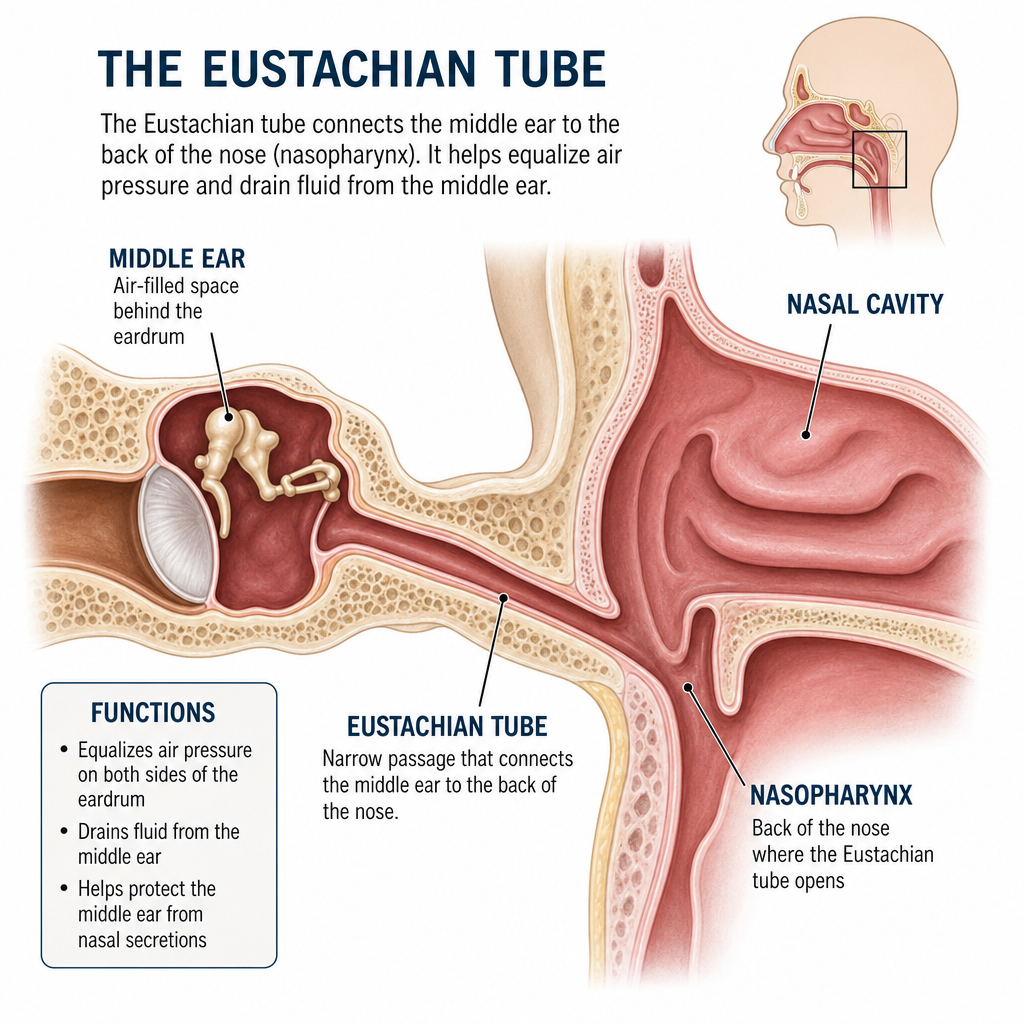
That pressure mismatch can create the exact sensations people kept describing:
- Water trapped in the ear
- Wet cotton packed inside
- Everything sounding like a tunnel
- A crackle that never becomes a complete opening
- Sound reaching you, but the words staying muffled
Once I saw the anatomy this way, the old search made no sense. The question was no longer: “What do I remove from the ear?”
The better question was:
“How do I help the pressure door open at the exact moment air is ready to move through it?”
THE 2-SECOND “PRESSURE WINDOW” HIDING IN PLAIN SIGHT
A swallow already tries to open the Eustachian tube. The problem is that the opening lasts only a moment.
If the air is not there when the passage opens, the ear can crackle, shift, almost clear—then stay exactly where it was.
The answer is not “blow harder.”
It is to build controlled airflow on the nasal side first, then swallow while that airflow is still running.
I call this the Seal-Air-Swallow Method.
SEAL
Seal the nosepiece against one nostril. Close the other nostril and keep your mouth closed so the airflow cannot escape.
BUILD
Activate the powered airflow and hold the seal for about 1-2 seconds. This places controlled air at the nasal side of the passage.
SWALLOW
Swallow while the airflow is still active. The swallow briefly opens the passage, giving the air a path toward the middle ear.
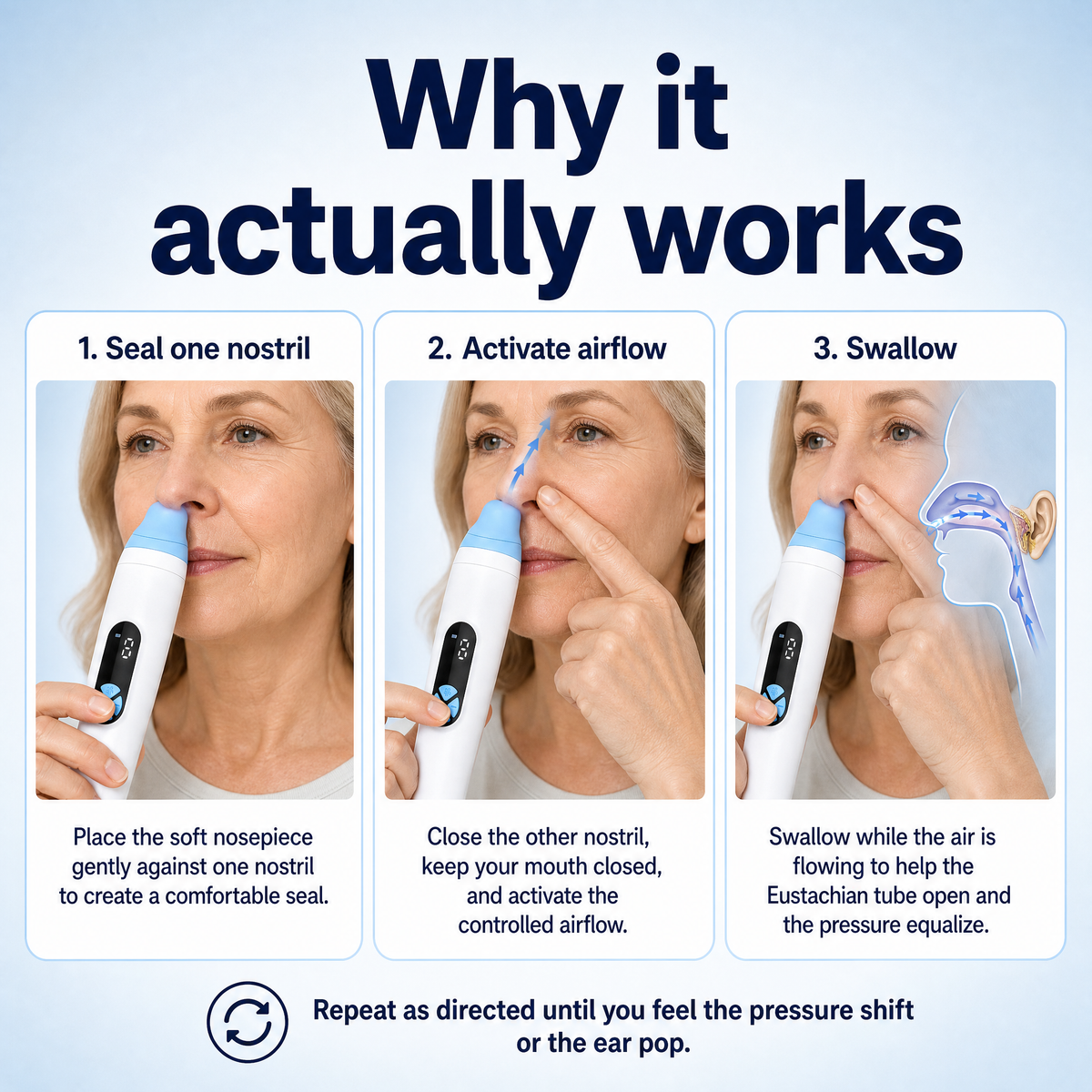
The seal keeps the air from leaking out. The powered airflow creates the pressure movement. The swallow opens the door.
Miss the seal and the air escapes.
Swallow after the airflow stops and the pressure window closes.
Force a harder pop without controlling either event and you are still guessing.
Seal. Build. Swallow.
No water is required. No pill. No liquid inside the ear. Nothing inserted into the ear canal.
EVERYTHING YOU TRIED WAS AIMED AT A DIFFERENT JOB
This is the part that made me angry—not because the old options are scams, but because people were using them for a physical job they were never designed to perform.
WAX DROPS AND FLUSHING
They work in the visible canal. They cannot open the pressure door behind the eardrum when there is no wax to remove.
SPRAYS AND DECONGESTANTS
They may help congestion. They do not coordinate powered airflow with the precise moment the Eustachian tube opens.
YAWNING, CHEWING, AND SWALLOWING
They may briefly open the passage. They do not place controlled airflow behind that opening while it happens.
PINCHING AND BLOWING HARDER
It creates self-generated force. More force is not the same as a repeatable seal, powered airflow, and timed swallow.
That explains why someone can say, “I tried everything,” and mean it.
They tried everything for the canal. Everything for congestion. Everything for one lucky pop.
What they did not have was a controlled way to place air at the nasal side of the Eustachian tube during the brief swallow window.
Once that became the standard, the product stopped looking like a random gadget.
It became the inevitable tool for the method.
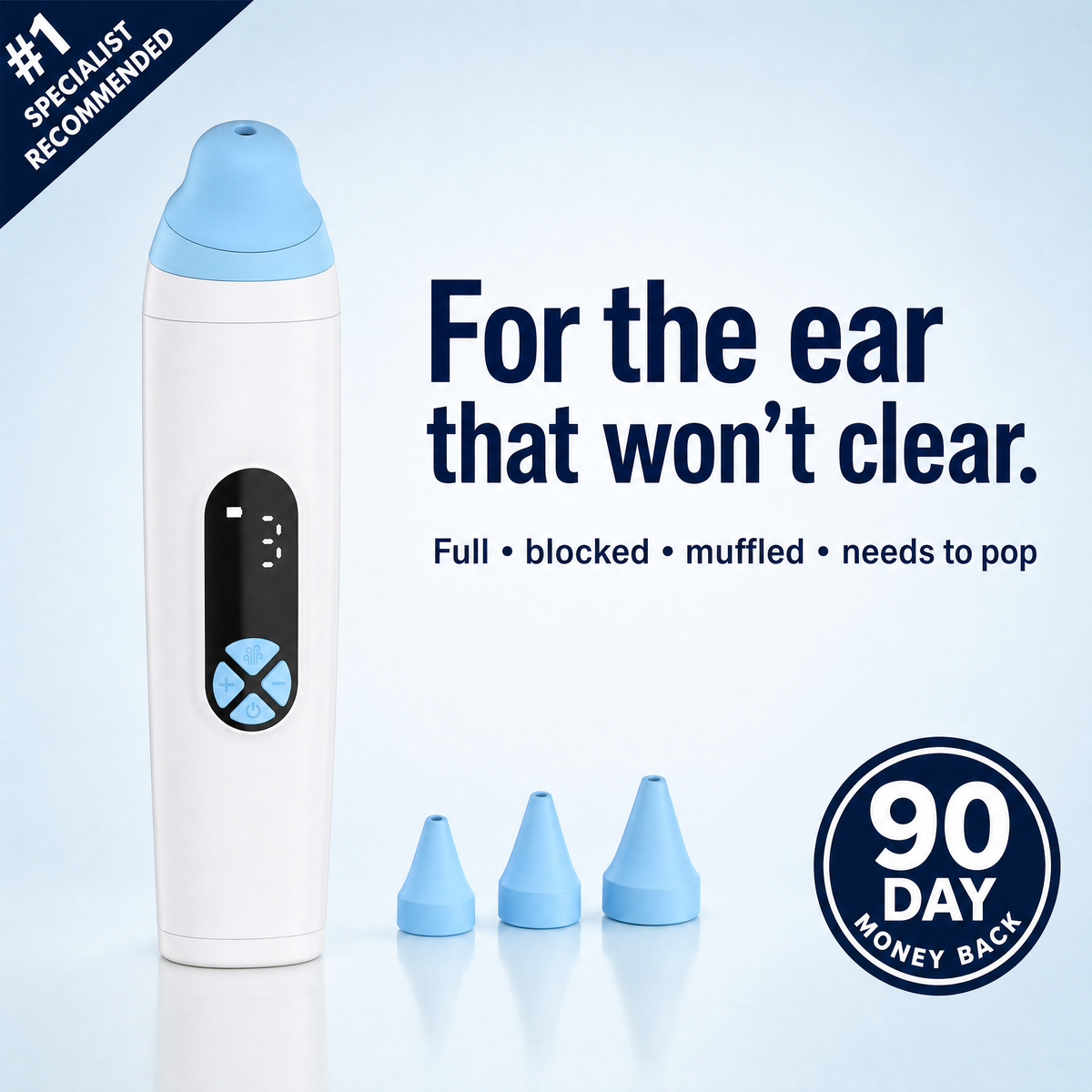
THE POWERED TOOL BUILT FOR THE EXACT MOMENT YOUR EAR TRIES TO OPEN
That tool is Arcelux.
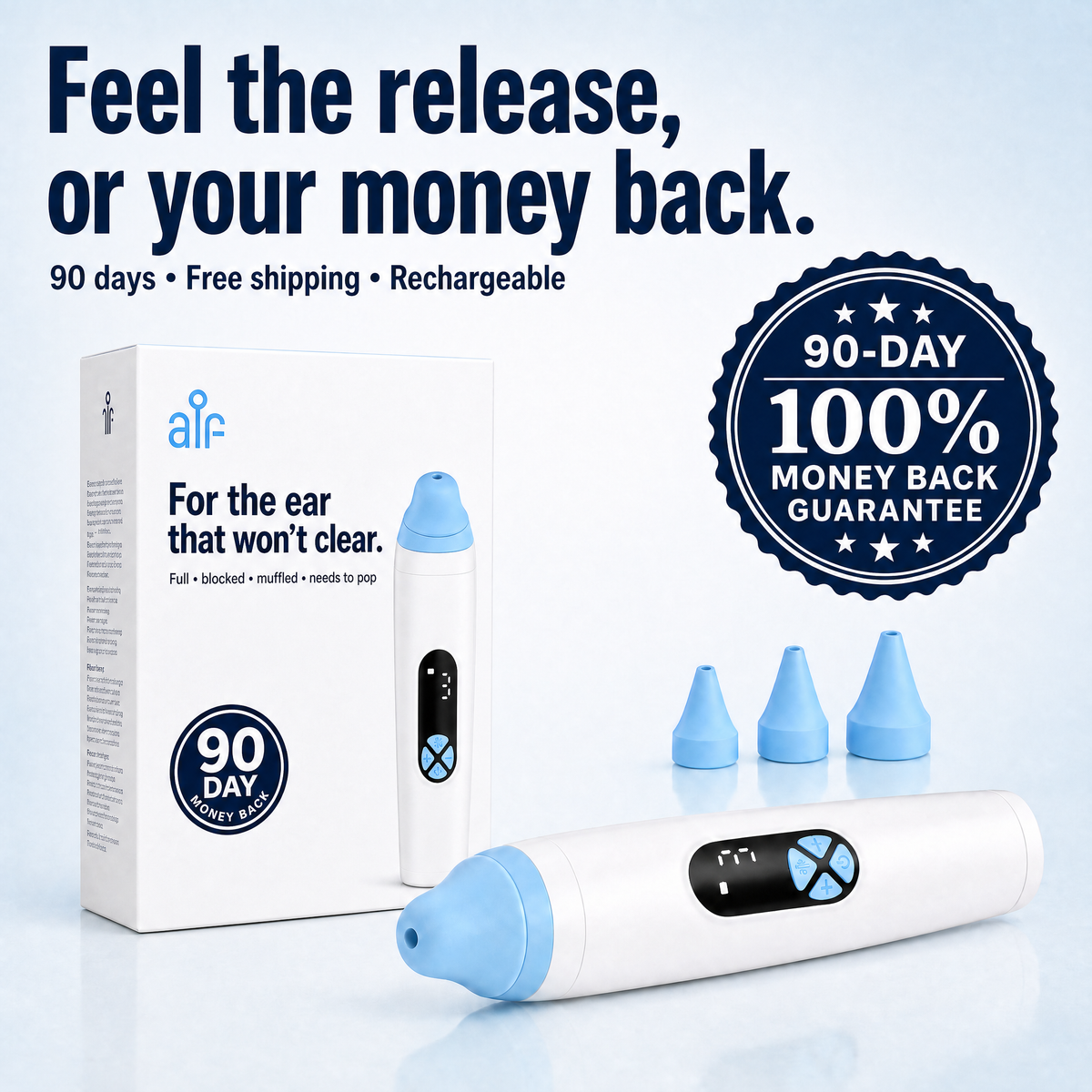
Arcelux is a rechargeable powered nasal-airflow device built around one narrow job: send controlled air through the nose while you swallow, helping the Eustachian tube open so pressure can move behind the eardrum.
- Powered, controlled airflow
- Works through the nose—not inside the ear
- Timed with the swallow that opens the tube
- Rechargeable and reusable at home
- 90-day money-back guarantee
It is not another drop. It is not another spray. It is not a supplement waiting weeks to build up.
It gives you the same controlled sequence whenever the pressure-driven blocked feeling returns: seal, build, swallow.
HERE IS EXACTLY WHAT HAPPENS WHEN YOU USE IT
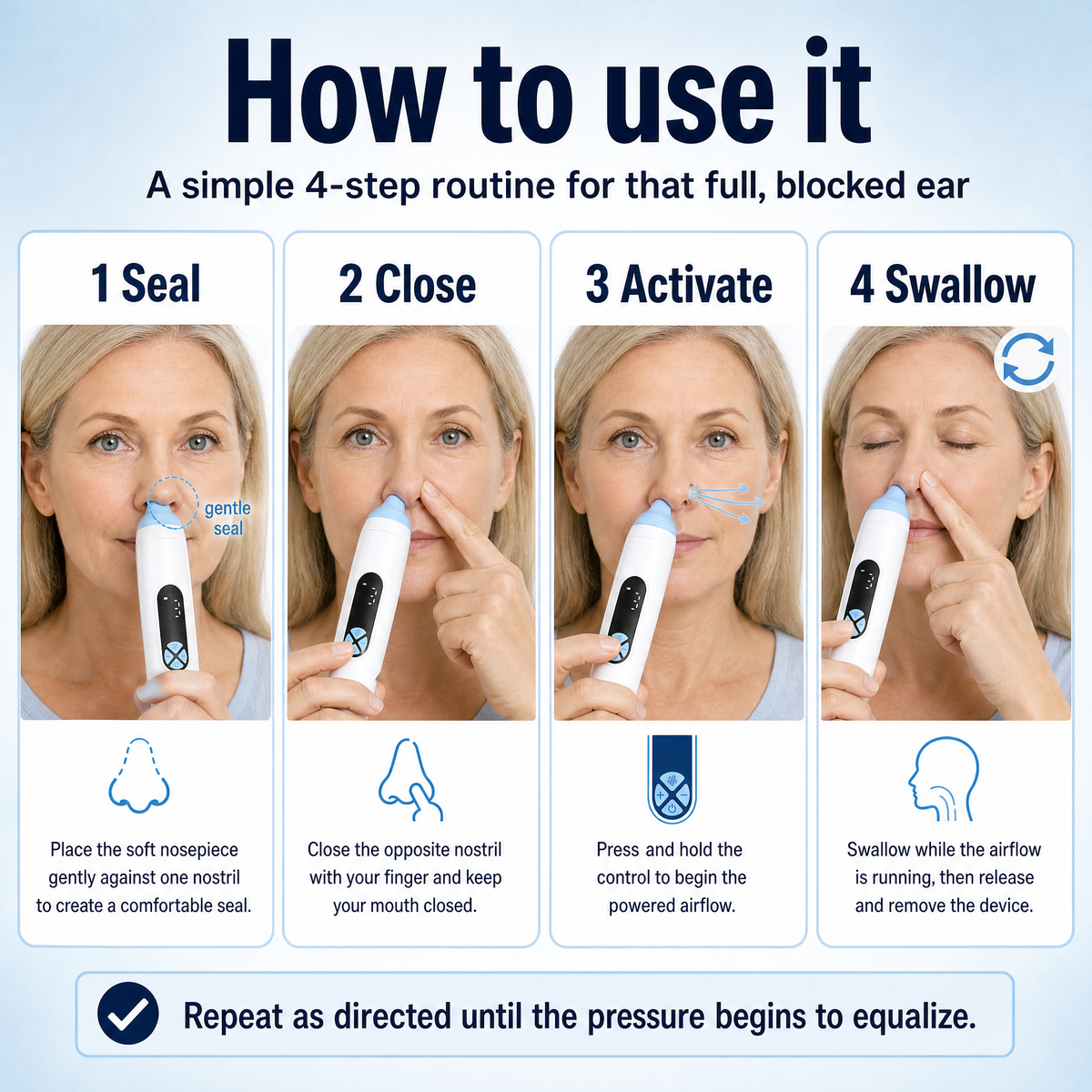
0 seconds: Create the seal.
Place the nosepiece against one nostril. Close the opposite nostril. Keep your mouth closed. This matters because every open escape route bleeds away the pressure movement before it reaches the back of the nose.
1-2 seconds: Let the powered airflow build.
Arcelux sends controlled air into the nasal passage. You are not trying to force the ear open. You are placing air beside the pressure door before it opens.
While the airflow is still active: Swallow.
The swallow briefly opens the Eustachian tube. Because the airflow is already present, air can move through the passage toward the middle ear and help balance the pressure across the eardrum.
You may notice a pop. A click. Fluid movement. A pressure shift. Or simply that the ear feels more open and words sound less buried.
The dramatic sound is not the goal.
The ear feeling open enough to hear the sentence is the goal.
IF THE FIRST ATTEMPT DOES NOTHING, CHECK THESE THREE THINGS
1. The seal: If air blows back into your mouth or escapes around the nosepiece, the seal is incomplete.
2. The timing: Let the airflow build for about 1-2 seconds, then swallow while it is still active.
3. The cause: Arcelux is built for pressure-related blockage. It cannot remove wax, treat infection, or correct every cause of hearing difficulty.
THE TEACHER’S ENDING
Remember the teacher whose review started this investigation?
The one who could not hear her students asking questions or her colleagues speaking?
After using the same powered nasal pressure-balancing device model, she wrote two words:
“I cried!” Verbatim exact-product review • Review 37
Then she called the experience:
“A literal miracle.” The same reviewer • Review 37
That is the emotional distance between a device that looks almost too simple and an ear that finally feels different.
Before: missing her own students’ questions.
After: tears.
Not because she wanted to hear a clever pop.
Because she wanted back into the conversation.
WHAT ALL 180 REVIEWS ACTUALLY SHOWED
I did not stop at the teacher’s result.
I kept the successes, the partial results, the technique failures, and the outright non-responses in the same analysis.
Source: 180-review exact-product corpus. Counts overlap because one review may contain more than one theme. These are reviews of the same powered device model, not presented as Arcelux-branded testimonials.
The timeline was not identical for everyone.
One reviewer wrote: “Within two seconds… my ear popped and was 100% better.”
Another said: “It did not work initially but I kept trying and eventually it worked.”
Another: “Day 6 it started clearing up, day 7 completely cleared.”
That variation makes the pattern more believable, not less.
Some ears move quickly. Some need the seal and swallow timing corrected. Some improve in stages. Some do not respond because pressure is not the reason they feel blocked.
“OMG tears… it popped my ears.”Verbatim exact-product review • Review 7
“I CAN HEAR I CAN HEAR AFTER WEEKS!!!!!”Verbatim exact-product review • Review 33
“The color returns to the world.”Verbatim exact-product review • Review 9
“Worth every penny spent.”Verbatim exact-product review • Review 7
BUT HERE IS THE CATCH—AND IT MATTERS
Forty-seven reviews described no result or no meaningful relief.
I am not hiding that number because the product is not the answer to every reason an ear can feel clogged.
Arcelux does not remove wax.
It does not treat an ear infection.
It does not reverse permanent hearing loss.
And it should never be used to delay evaluation for sudden hearing loss, drainage, severe pain, vomiting, or significant dizziness.
It performs one physically understandable job:
It gives a pressure-driven blocked ear controlled nasal airflow timed with the swallow that opens the Eustachian tube.
That narrow job is exactly why the product makes sense.
If wax is the problem, remove the wax.
If infection or sudden hearing loss is the problem, get medical care.
But if the canal is clear, the ear still feels full or muffled, it crackles like it wants to open, and the pressure pathway is not equalizing—this is the direct action built for that moment.
THE PRICE OF ANOTHER MONTH WITH THE SAME EAR
The blocked-ear buyer rarely arrives after doing nothing.
There are the sprays. Drops. Decongestants. Antihistamines. Wax kits. Sinus rinses. Heat packs. Massage tools.
Then the doctor visit. Hearing test. ENT copay. Another appointment. Another wait.
And every failed purchase creates the same ugly question:
“How much more am I supposed to spend before I get one direct thing I can try at home?”
The teacher answered the price objection in one sentence:
“The ENT copay will be the same or more.” Verbatim exact-product review • Review 37
Arcelux is rechargeable. It is reusable. It stays with you.
When the pressure-driven blocked feeling returns, you do not start the search from zero.
You already have the controlled sequence in your hand.
THE 90-DAY “TRY THE METHOD, NOT ANOTHER GUESS” GUARANTEE
I understand the skepticism. The device looks simple because the physical job is simple.
But simple does not mean careless.
You need time to learn the seal, get the swallow timing right, and decide whether pressure equalization is the missing action for your ear.
That is why Arcelux is backed by the current 90-day money-back guarantee shown on the official product page.
Try the actual method. Judge the pressure shift, the more-open feeling, and the ordinary moments that matter.
THE CHOICE THAT DECIDES YOUR NEXT “WHAT?”
You can keep waiting for the ear to decide when it opens.
Yawn. Swallow. Pull the earlobe. Pinch the nose. Try another spray. Check for wax again.
Move the phone to the better side.
Turn the television up.
Ask “what?” once.
Ask again.
Then nod because asking a third time feels worse.
Or you can use the pathway that actually connects to the middle ear.
Controlled airflow through the nose.
Timed with the swallow that opens the Eustachian tube.
A direct physical action you can repeat at home.
The teacher whose words started this investigation did not want “ear wellness.”
She wanted to hear her students asking questions.
That is the real outcome.
Hear the sentence. Stay in the conversation. Stop waiting for one random good-ear day.
BEFORE YOU TRY IT…
HERE IS EXACTLY WHAT TO DO NEXT
- Open the official Arcelux product page below.
- Choose the current option that makes sense for you.
- When it arrives, watch the complete demonstration before judging the device.
- Seal one nostril, close the other, keep your mouth closed, and activate the airflow.
- Wait about 1-2 seconds, then swallow while the airflow is still active.
- If nothing happens, correct the seal and timing before deciding it does not work.
- Stop immediately if it causes pain, strong dizziness, nausea, or worsening symptoms.
But whatever you do, do not close this page and return to the same drawer of sprays and drops as though you learned nothing.
The canal is not the only place a clogged ear can come from.
The pressure door sits behind the eardrum.
The opening is reached through the nose.
Seal. Build. Swallow.
With hope,
The researcher behind Arcelux’s blocked-ear analysis
P.S. If your ear feels clogged but there is no wax to remove, stop treating the visible canal as the only place that matters. The pressure-balancing passage sits behind the eardrum and opens at the back of the nose.
P.P.S. The method is not “blow harder.” It is controlled timing: seal the nostril, activate the airflow, let it build for about 1-2 seconds, then swallow while it is still running.
P.P.P.S. Some reviewers felt the shift quickly. Others needed repeated correct use. The promise is not one permanent magic pop. It is finally having a direct, repeatable action when the pressure-driven blocked feeling will not clear.